
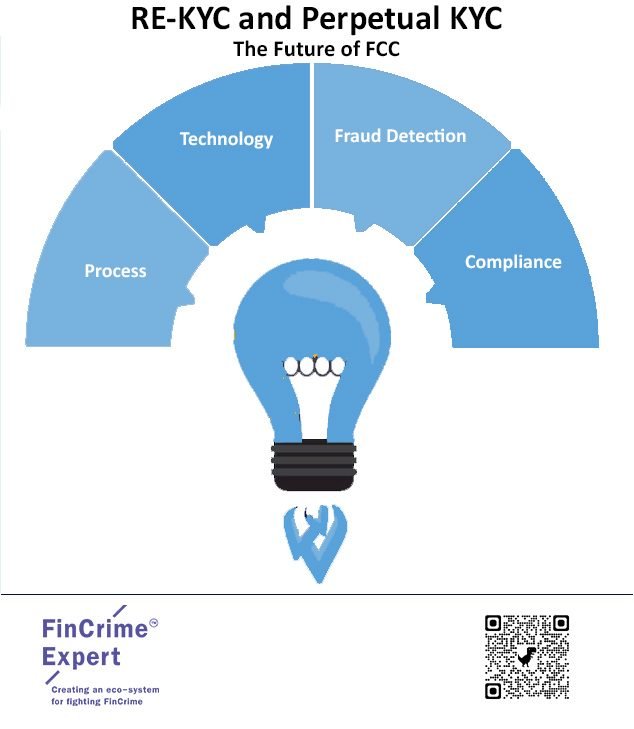
RE-KYC and Perpetual KYC – The Future of FCC
With digital banking and fintech transforming financial services, Know Your Customer (KYC) processes have evolved from a one-time requirement to a continuous compliance obligation. Regulatory bodies like RBI, SEBI, and FATF emphasize real-time customer due diligence to mitigate financial fraud, money laundering, and terrorist financing risks.
This article explores RE-KYC and Perpetual KYC, their necessity, impact, and India’s regulatory stance in alignment with FATF recommendations.
What is RE-KYC?
RE-KYC (Re-Know Your Customer) is the periodic process of updating and revalidating customer identity details in banks, NBFCs, and financial institutions
Why is RE-KYC Necessary?
- Regulatory Compliance: Ensures adherence to RBI, SEBI, and FATF AML/CFT guidelines
- Fraud Prevention: Protects against identity theft, money laundering, and unauthorized transactions
- Risk-Based Monitoring: Enables financial institutions to assess customer risk profiles dynamically
How is RE-KYC Done?
- Online RE-KYC: Aadhaar-based, OTP, or video KYC verification
- Offline RE-KYC: Document submission at banks/NBFC branches
- CKYC (Central KYC Registry): Centralized compliance using government-linked KYC databases
RBI RE-KYC Guidelines (2024 Update): Reserve Bank of India
What is Perpetual KYC?
Unlike RE-KYC, Perpetual KYC (P-KYC) automates and continuously updates customer information in real-time. AI-driven analytics, blockchain-based identity verification, and API integrations eliminate manual periodic KYC renewals
Benefits of Perpetual KYC
- Real-Time Compliance: Continuous monitoring of customer behavior and financial transactions
- Automated Risk Scoring: AI classifies customers into low, medium, and high-risk categories dynamically
- Fraud Detection: Detects suspicious transactions, money laundering, and identity fraud proactively
FATF Digital Identity & KYC Compliance (2024): Financial Action Task Force
Key Differences: RE-KYC vs. Perpetual KYC
| Feature | RE-KYC | Perpetual KYC |
|---|---|---|
| Process | Manual, periodic updates | AI-driven, real-time updates |
| Technology | Document-based verification | API, AI, and blockchain-based |
| Fraud Detection | Reactive | Proactive |
| Compliance | RBI-mandated scheduled updates | Emerging global best practice |
CKYC Registry India: Central KYC Registry
Why Are These KYC Models Becoming Mandatory?
The shift from traditional RE-KYC to Perpetual KYC is driven by:
- Increased Financial Crime & Cyber Fraud: India reported a 150% rise in digital frauds (2023-24)
- Regulatory Push for Continuous Monitoring: FATF requires real-time risk-based KYC for AML compliance
- Growth of Digital Banking & Open Finance: More transactions demand instant, automated compliance mechanisms
FATF AML/CFT Risk-Based Approach (2024): FATF Official Guidelines
India’s Regulatory Framework for RE-KYC & Perpetual KYC
1. RBI Regulations
- Banks & NBFCs must conduct RE-KYC at set intervals (1-10 years)
- Video-KYC & Aadhaar-based verification now permitted for faster compliance
- High-risk customers require annual KYC updates
RBI RE-KYC Circular (2024): Reserve Bank of India
2. SEBI Regulations for Investment & Trading Accounts
- Mandatory Perpetual KYC for stockbrokers, mutual funds, and fintech platforms
- AI-based monitoring for high-frequency traders and digital investment apps
SEBI KYC Compliance (2024): SEBI Official Site
3. CKYC Registry & Perpetual KYC
- CKYC enables cross-platform KYC verification for banks, NBFCs, and payment wallets
- Government API integration eliminates redundant KYC updates
India’s Central KYC System: CKYC India
How Financial Institutions Can Implement Perpetual KYC
| Action | Implementation Strategy |
|---|---|
| AI-Based Risk Profiling | Automates customer categorization |
| Blockchain Identity Verification | Ensures tamper-proof KYC records |
| API-Driven KYC Updates | Seamless Aadhaar, PAN, UPI integration |
| Continuous Transaction Monitoring | Detects fraud before regulatory violations occur |
FATF’s Future of Digital KYC (2024): FATF Report
RE-KYC and Perpetual KYC are reshaping financial compliance in India. With growing AML/CFT risks and RBI/FATF regulations tightening, financial institutions must transition from periodic KYC updates to AI-driven, real-time compliance models
By leveraging digital identity verification, AI-based fraud detection, and automated risk profiling, financial firms can ensure seamless compliance, improved security, and better customer experience in 2024 and beyond
Originally published on FinCrime Expert